



Executive summary
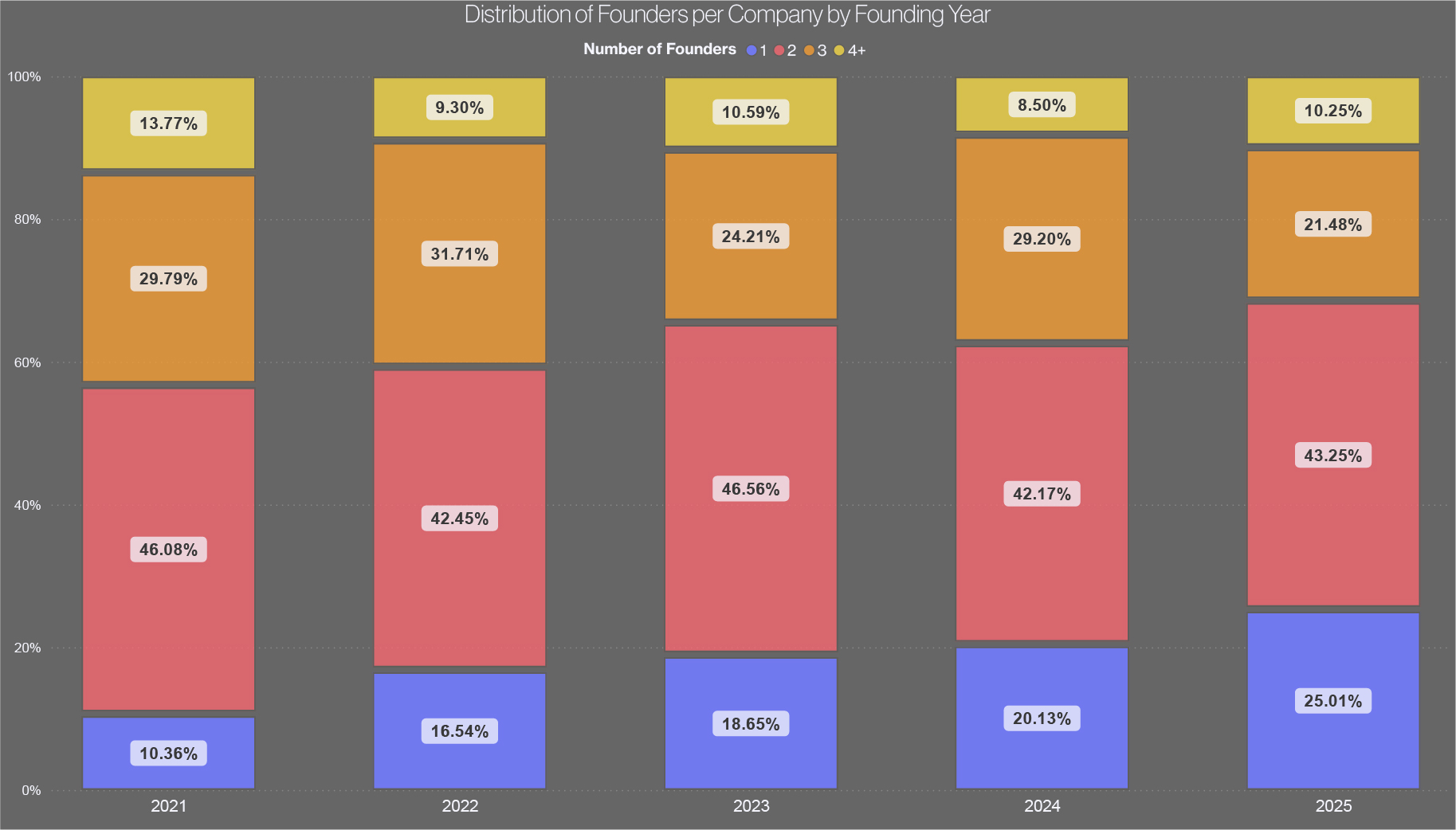
Starting a company alone is no longer the exception. In our data on companies founded from 2021 to 2025, solo founders rose from about 10% of new companies to about 25%. Two-founder teams barely moved, holding between 42% and 47% in every year, and remain the most common structure. The teams that thinned out are the large ones, with three founders or four or more. Team size also shapes each founder's stake: founders hold about half the company after Seed, so two founders splitting evenly hold about a quarter each, while a solo founder keeps all of it and carries the whole load. Whether the pair is the lasting structure, or just the slowest to change, is still an open question.
Solo founders more than doubled
In our data on companies founded from 2021 to 2025, solo founders rose from about 10% of new companies to about 25%. Starting alone is no longer the exception.
The pair did not lose ground
Two-founder teams held between 42% and 47% in every year from 2021 to 2025, and they are still the most common structure in every cohort. The teams that thinned out are the large ones, with three founders or with four or more. The solo founder is replacing the large team, not the pair.
What could be behind it
We see a few likely drivers. AI tools may be covering skill gaps that used to need a third or fourth founder. Investors may still prefer two people over one, which would explain why the pair held. And some solo companies may stay small and raise later, if at all. The data does not separate these, but all three point the same way: smaller founding teams.
What team size means for your equity
Team size decides how the founders' share is split. In our data, founders hold about half the company after Seed. Split evenly between two founders, that is about a quarter each. A solo founder keeps all of it, and carries the whole load alone.
If you are deciding how many co-founders to bring in, settle the equity questions early:
- How the founder stake is split, and whether the split reflects roles and commitment.
- Whether founder shares vest, and over what period.
- What happens to unvested shares if a co-founder leaves early.
These are much easier to agree on in the first month than in the second year.
Frequently asked questions
DISCLAIMER
This report is issued by and on behalf of altshare Ltd. ("altshare") for informational purposes only and shall not be construed as legal, financial, tax, investment, or other professional advice. The information contained in this report is based on aggregated and anonymized data provided to and/or prepared by altshare for its clients.
While this report may address potential legal, financial, and/or tax matters, it does not constitute professional advice in these areas. Any analyses, trends, observations, or conclusions presented herein are based on altshare's analysis of the underlying data and are provided for informational purposes only.
We strongly recommend that you seek the counsel of qualified advisors before taking any actions based on the information provided in this report.
For the avoidance of doubt, altshare shall not assume any liability for, nor be held responsible for any damages, losses, claims, or expenses, whether direct, indirect, incidental, consequential, special, or punitive, arising from the use or reliance on the information contained in this report. altshare shall not be liable for any actions taken or not taken based on the information contained herein.
altshare does not warrant the accuracy, completeness, or reliability of the data presented, and assumes no responsibility for any errors or omissions.
The information provided in this report is subject to change without notice. This report is provided "as is" and altshare disclaims any responsibility for the outcomes of decisions made by the recipient or any third party in reliance on its contents.