


Executive Summary
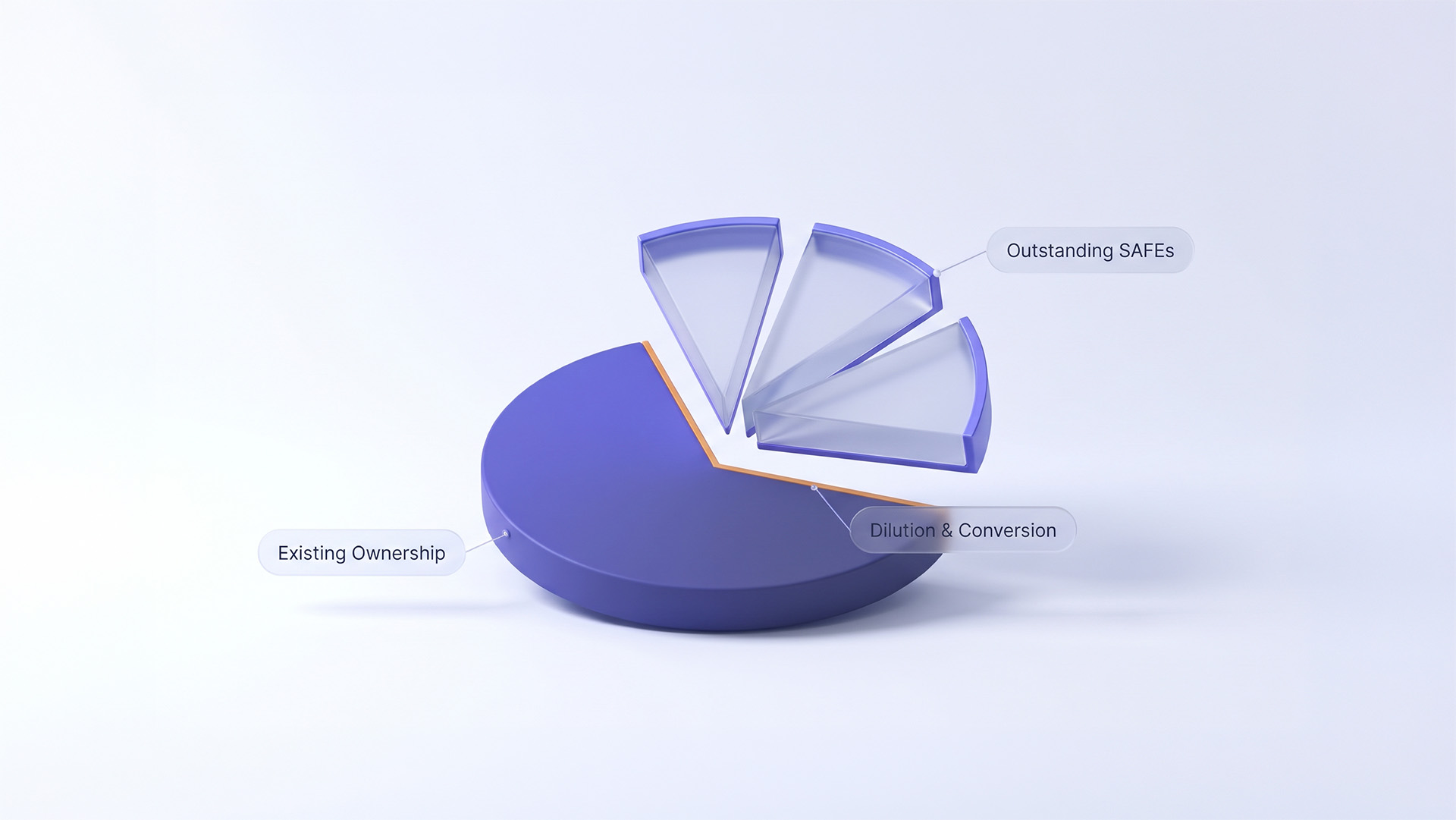
Simple Agreements for Future Equity (SAFEs) allow startups to raise capital without immediately issuing shares or establishing a fixed company valuation. While this flexibility makes SAFEs an attractive financing instrument, it can also create a misleading perception that existing shareholders have not been diluted.
In reality, outstanding SAFEs represent contractual rights to future equity. When these instruments convert, the resulting share issuance can significantly change the company's capitalization structure and reduce the ownership percentages of founders and existing shareholders.
The impact becomes particularly important when companies have multiple outstanding SAFEs with different valuation caps, discounts, and conversion terms.
Understanding potential dilution before conversion is essential for effective capitalization management, future fundraising decisions, and 409A valuations.
The Dilution You Don't See
One of the most attractive features of a SAFE is that it allows a company to receive funding without immediately issuing shares.
Unlike a priced equity round, where investors receive shares upon closing, SAFE investors generally receive contractual rights to equity that will be issued upon a future triggering event, typically a qualified financing round.
As a result, a company's current capitalization table may show no change in the number of outstanding shares following a SAFE investment.
However, an unchanged share count does not necessarily mean that the economic ownership structure remains unaffected.
Consider a company with 10 million outstanding shares, all held by its founders. The company raises $2 million through SAFEs, but no new shares are issued at the time of investment.
From the current legal ownership perspective, the founders still hold 100% of the outstanding shares.
Economically, however, a portion of the company's future equity has already been contractually committed to SAFE investors.
The distinction between current ownership and potential future ownership is where hidden dilution begins.
When SAFEs Convert: Understanding the Mechanics
The dilution resulting from a SAFE depends primarily on the number of shares issued upon conversion.
That number is determined by the investment amount and the applicable conversion price, which depends on the specific terms of the agreement.
Two common mechanisms influence the conversion price:
Valuation Cap: Establishes a contractual ceiling used to calculate the investor's conversion price. When the company's valuation in a subsequent financing round exceeds the cap, the SAFE investor may convert at a more favorable price than the new investors.
Discount: Allows the SAFE investor to convert at a predetermined discount to the share price paid by investors in the subsequent financing round.
Depending on the agreement, the investor may benefit from the mechanism producing the more favorable conversion price.
Consequently, two SAFE investors who contributed identical amounts may ultimately receive different numbers of shares.
The distinction between pre-money and post-money SAFEs is also important. Post-money SAFEs generally provide greater visibility into the ownership percentage attributable to the SAFE investment before the new financing, while pre-money SAFEs can produce different dilution outcomes depending on other outstanding instruments and the capitalization definition.
The conversion mechanics, rather than the investment amount alone, determine how much future ownership is transferred.
The Hidden Impact of Multiple SAFEs
The potential dilution becomes more complex when a company raises capital through several SAFE agreements over time.
Early-stage companies frequently execute multiple SAFEs at different stages of development, sometimes with different investors, valuation caps, and contractual provisions.
Each SAFE may appear manageable when considered individually. However, their combined conversion can create a substantially different ownership structure from the one reflected in the company's current capitalization table.
Consider the following simplified example.
A company has 10 million existing shares, all held by its founders, and has raised capital through three post-money SAFEs:
| SAFE | Investment Amount | Post-Money Valuation Cap |
|---|---|---|
| SAFE A | $500,000 | $5 million |
| SAFE B | $750,000 | $10 million |
| SAFE C | $750,000 | $15 million |
| Total | $2,000,000 |
For illustration purposes, assume that all three SAFEs convert in a subsequent priced financing at their respective valuation caps, without applicable discounts, additional convertible securities, or option pool adjustments.
Under these assumptions, the implied ownership attributable to each post-money SAFE immediately before the new financing is:
- SAFE A: 10.0%
- SAFE B: 7.5%
- SAFE C: 5.0%
Together, these SAFEs represent 22.5% of the company's equity immediately before the new financing investment.
The founders' ownership would therefore decrease from 100% to 77.5%, even before accounting for the dilution associated with the new money invested in the priced round.
Ownership Before and After SAFE Conversion
| Shareholder | Before Conversion | After SAFE Conversion |
|---|---|---|
| Founders | 100.0% | 77.5% |
| SAFE A Investor | — | 10.0% |
| SAFE B Investor | — | 7.5% |
| SAFE C Investor | — | 5.0% |
| Total | 100.0% | 100.0% |
The example demonstrates how a company can maintain an unchanged capitalization table throughout several fundraising transactions, while simultaneously accumulating contractual commitments that materially affect future ownership.
If the subsequent priced round introduces additional investors, the founders' ownership will generally be diluted further.
Actual results depend on the specific SAFE agreements, applicable conversion prices, capitalization definitions, and financing terms.
Why the Next Financing Round Can Reveal Unexpected Dilution
The consequences of outstanding SAFEs often become most visible when a company prepares for its next priced financing round.
At that point, the company must determine how existing SAFEs will convert, how many shares will be issued, and how the resulting capitalization structure will affect both existing and incoming investors.
This process may reveal a meaningful difference between the ownership percentages founders have been monitoring and their expected ownership following the financing.
The effect can become even more significant when the financing includes an expansion of the employee option pool.
For founders and CFOs, understanding these outcomes before negotiating a new financing round is essential.
A company that evaluates its capitalization structure solely on the basis of currently outstanding shares may underestimate the combined dilution associated with SAFE conversion, option pool adjustments, and new equity issuance.
This is why capitalization planning should extend beyond the current cap table and incorporate forward-looking conversion scenarios.
Why Outstanding SAFEs Matter for 409A Valuations
The economic implications of outstanding SAFEs are also relevant when determining the Fair Market Value (FMV) of a company's Common Stock.
A 409A valuation requires an assessment of the company's equity value and its allocation among the various securities and contractual claims within the capital structure.
Outstanding SAFEs may affect this analysis even when they have not yet converted into shares.
From a valuation perspective, several factors must be considered:
- The contractual terms governing each SAFE's conversion.
- The expected timing and circumstances of a future financing or liquidity event.
- The number and class of shares that may be issued upon conversion.
- The economic rights associated with the resulting securities.
- The effect of potential conversion on the allocation of equity value among existing and future shareholders.
Depending on the valuation methodology and expected scenarios, outstanding SAFEs may need to be incorporated into the capitalization analysis or modeled separately to reflect their economic rights.
Importantly, the dilution percentage associated with a SAFE does not translate directly into an equivalent reduction in the FMV of Common Stock.
The valuation outcome depends on the company's total equity value, the rights and preferences of its securities, the applicable allocation methodology, and the assumptions underlying the analysis.
Accordingly, a reliable 409A valuation requires more than a review of the shares currently outstanding. It requires an understanding of the contractual claims that may reshape the company's equity structure.
From the Valuation Desk
One of the recurring challenges we encounter when analyzing early-stage companies is the gap between the capitalization structure reflected in the current cap table and the structure that may emerge following the conversion of outstanding SAFEs.
This becomes particularly relevant when companies have raised capital through several SAFE agreements with different valuation caps or conversion provisions.
Although each agreement may appear straightforward on its own, the combined effect can materially change ownership allocations and introduce additional complexity into the valuation process.
From a valuation perspective, understanding these contractual commitments is essential not only for estimating potential dilution, but also for appropriately reflecting the economic interests of the different security holders.
Key Takeaways
- No immediate share issuance does not mean no future dilution. Outstanding SAFEs can create contractual commitments to future equity even while the current share count remains unchanged.
- Conversion terms determine the economic outcome. Valuation caps, discounts, and pre-money versus post-money structures can materially influence the number of shares ultimately issued.
- Multiple SAFEs can create significant cumulative dilution. Their combined impact may be substantially greater than founders anticipate when reviewing each agreement individually.
- Forward-looking capitalization modeling is essential. Companies should evaluate SAFE conversion alongside future financing rounds and option pool adjustments.
- Outstanding SAFEs matter for 409A valuations. Their contractual rights and potential conversion outcomes may influence how equity value is allocated and how the FMV of Common Stock is determined.
The central question is not simply how much capital a company has raised through SAFEs, but how much of its future equity has already been committed.
Understanding that distinction allows founders, investors, and finance teams to make more informed decisions before dilution becomes visible on the capitalization table.
Frequently asked questions
Usually not on an issued-and-outstanding share basis because a SAFE is not stock before conversion. However, it can create pro forma dilution because it gives the investor contractual rights that may result in future shares or other payments under the agreement.
The calculation depends on the form. For a standard post-money valuation cap SAFE, the ownership sold is generally the purchase amount divided by the post-money valuation cap, before dilution from the priced-round investment and any new or increased option pool. Discount, MFN, pre-money, and customized instruments require different analysis.
A post-money SAFE is designed to make the ownership sold through the SAFE more visible before the priced round. A legacy pre-money SAFE can be diluted by other convertibles in the capitalization used for conversion, so the final ownership is less predictable until the financing terms and all outstanding instruments are known.
Yes. Founders may focus on each check separately and overlook the cumulative result. Standard post-money valuation cap SAFE percentages are generally additive, so the company should maintain a running pro forma ownership model.
They should be recorded and tracked even though they are not yet issued shares. A cap table system may show them as outstanding convertible instruments and may also provide a pro forma view of their potential conversion.
In a priced equity financing, outstanding SAFEs may convert before or alongside the new investment. Founders and existing holders can be diluted by the SAFE conversion, the new-money shares, and any option pool increase negotiated as part of the round.
They can. A valuation professional should consider all material facts and circumstances, including contractual rights that may affect the capital structure. The treatment depends on the instrument terms, expected scenarios, and valuation methodology.
No. The cap is a contractual input used to determine a conversion price under specified conditions. It does not automatically establish the company's current enterprise value, equity value, priced-round valuation, or 409A common stock fair market value.
Some SAFE forms and customized agreements can include both. The conversion provision determines how the two mechanisms interact and which price applies. Review the signed document rather than assuming a standard result.
Start with a reconciled list of all outstanding instruments, then model the applicable conversion terms together with the proposed round size and option pool. Compare the current, pre-financing, and post-financing ownership views. Counsel and valuation professionals should review the final legal and valuation treatment.