


Executive summary
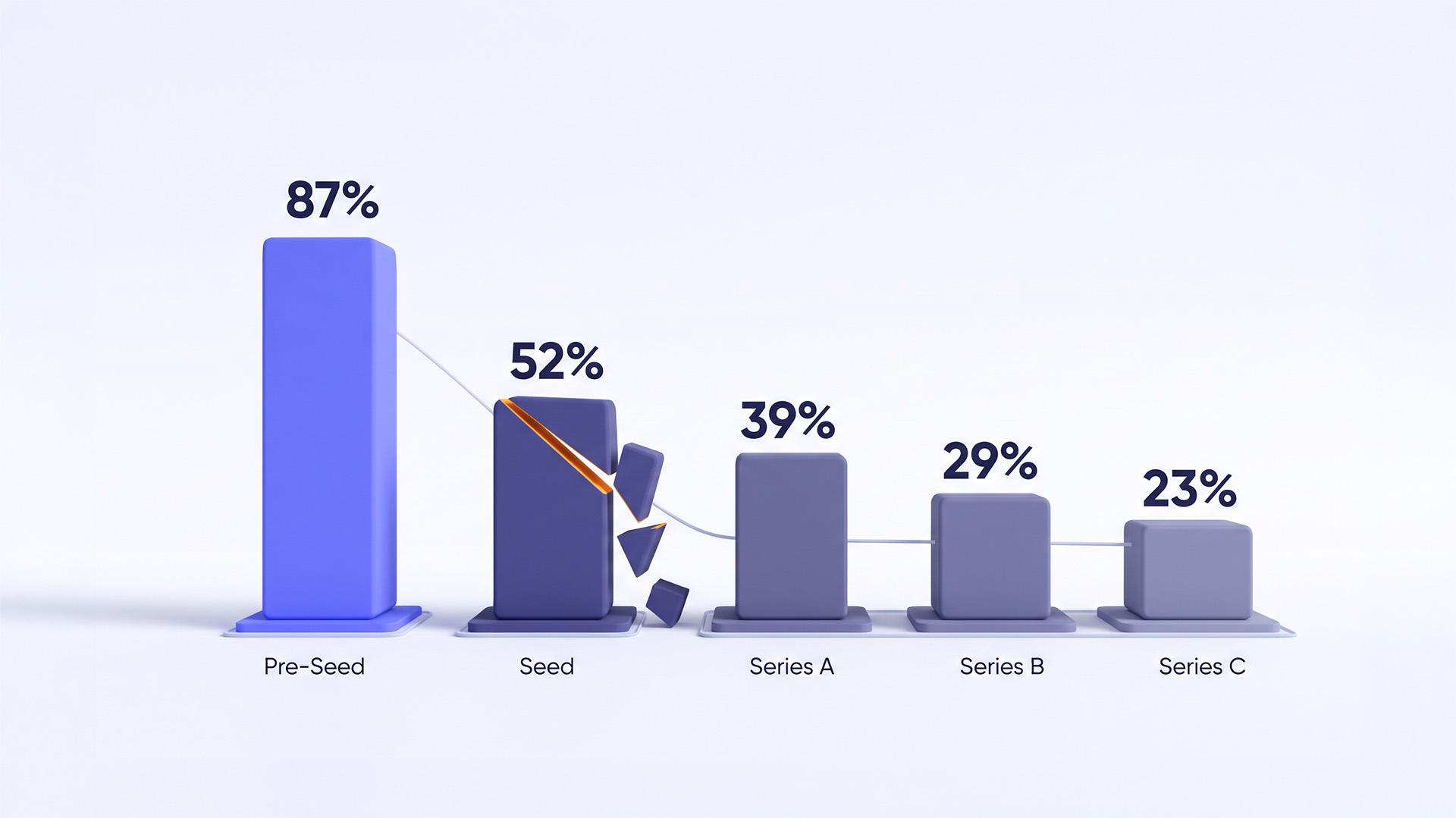
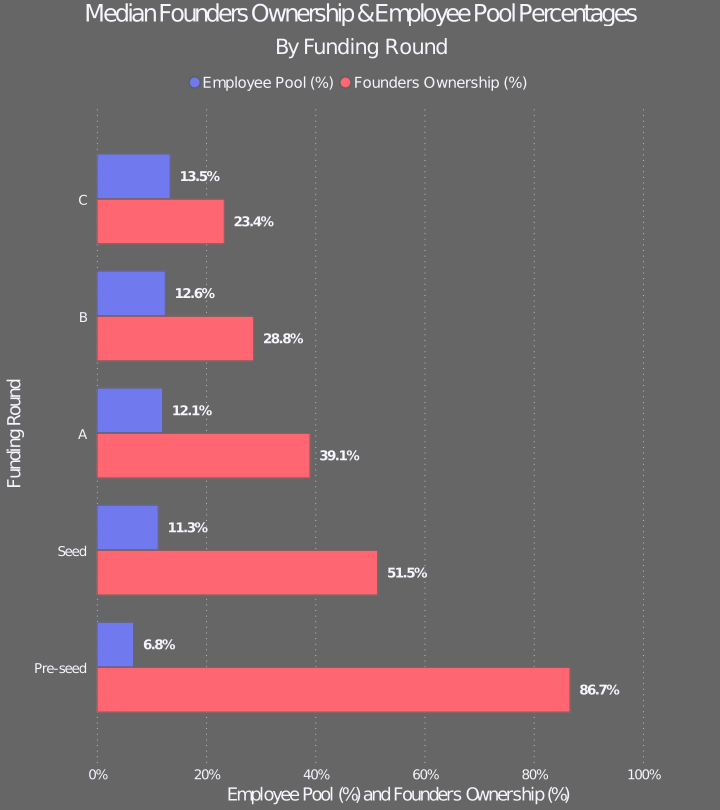
In our Q3 2026 data, a median founder holds 86.7% of the company at pre-seed and 51.5% at Seed, a drop of 35 percentage points in one step. Those 35 points are not the Seed round on its own. Every SAFE raised before a price converts on that day, and the option pool is topped up at the same time, from 6.8% to 11.3%. The rounds that follow cost much less: founders hold 39.1% at Series A, 28.8% at Series B and 23.4% at Series C, 28 points across three rounds. The check that moves founder ownership the most is the one raised before anyone sets a price. Founders should model SAFE conversion and the pool top-up before they sign a pre-seed SAFE, not when the Seed term sheet arrives.
The numbers
Most founders think of Seed dilution as the share they sell to the new Seed investors. Our data shows the full picture of what founders give up at that stage.
A median founder holds 86.7% at pre-seed and 51.5% at Seed. That is 35 percentage points in one step. After that the decline is slower:
- Series A: 39.1%
- Series B: 28.8%
- Series C: 23.4%
Three rounds combined cost 28 points, less than the single step at Seed.
Why Seed costs more than the Seed round
The Seed round itself is only part of those 35 points. The rest comes from everything else that happens on the same day.
First, every pre-seed SAFE converts. SAFEs are signed without a valuation and convert at the first priced round, so a year or two of SAFEs turns into shares at once.
Second, the option pool is topped up. In our data, the employee pool grows from 6.8% at pre-seed to 11.3% at Seed. That increase is usually created before the new money comes in, so it comes mostly out of existing holders, and founders are the largest existing holders.
The new money, the SAFE conversion and the pool top-up land together. That is the 35 points.
The check that moves ownership most comes before the price
In our view, the most important ownership decision in a founder's journey is not the Seed term sheet. It is the pre-seed SAFEs that convert into it. By the time the Seed term sheet arrives, much of the Seed dilution has already been decided.
What we suggest doing before Seed
- Model the full conversion of every SAFE at a realistic Seed valuation before you sign the next one.
- Raise the option pool size early in the Seed conversation, and ask whether it is calculated before or after the new money.
- Compare offers by your ownership after the round, not by the round alone.
- Keep the cap table and every instrument's terms in one place, so Seed day holds no surprises.
Frequently asked questions
DISCLAIMER
This report is issued by and on behalf of altshare Ltd. ("altshare") for informational purposes only and shall not be construed as legal, financial, tax, investment, or other professional advice. The information contained in this report is based on aggregated and anonymized data provided to and/or prepared by altshare for its clients.
While this report may address potential legal, financial, and/or tax matters, it does not constitute professional advice in these areas. Any analyses, trends, observations, or conclusions presented herein are based on altshare's analysis of the underlying data and are provided for informational purposes only.
We strongly recommend that you seek the counsel of qualified advisors before taking any actions based on the information provided in this report.
For the avoidance of doubt, altshare shall not assume any liability for, nor be held responsible for any damages, losses, claims, or expenses, whether direct, indirect, incidental, consequential, special, or punitive, arising from the use or reliance on the information contained in this report. altshare shall not be liable for any actions taken or not taken based on the information contained herein.
altshare does not warrant the accuracy, completeness, or reliability of the data presented, and assumes no responsibility for any errors or omissions.
The information provided in this report is subject to change without notice. This report is provided "as is" and altshare disclaims any responsibility for the outcomes of decisions made by the recipient or any third party in reliance on its contents.