


This accounting protocol, governed by ASC820 (Accounting Standards Codification Topic 820), often becomes a massiveoperational bottleneck during quarter-end and year-end audit cycles. Withoutstandardized processes, finance teams find themselves drowning in complexvaluation models, back-and-forth auditor requests, and anxious queries from LimitedPartners (LPs).
ASC 820is the US GAAP accounting standard that defines Fair Value and outlinesthe structured framework for measuring it. In the context of private equity andventure capital, an ASC 820 valuation is the objective determination ofthe price at which an illiquid asset (like startup preferred stock, warrants,or convertibles) would be exchanged between willing market participants in anorderly transaction on the measurement date.
Unlike public equities, which tradecontinuously on open exchanges, private startup investments do not have activedaily ticker prices. Fund managers cannot simply look at a screen to calculatetheir fund's Net Asset Value (NAV). Instead, they must apply mathematicallyrigorous, audit-defensible valuation methodologies to determine what thoseholdings are actually worth.
To help auditors and LPs understandthe reliability of a fund's asset valuation, ASC 820 categorizes inputs intothree distinct levels:
▲Level 1: Quoted Prices in Active Markets (e.g., Public Stock Tickers)
│
├─ Level 2: Observable Inputs (e.g., Recent Funding Round Priceper Share)
│
▼ Level 3: Unobservable Inputs (e.g., Financial Forecasts,Discounted Cash Flows)
Because private startup investments have no public market ticker,they are almost universally classified as Level 3 Assets. This meansyour valuation cannot rely on simple market data; it must be backed by formalvaluation models, market comparables, and internal company forecasts.
When valuing private market assetsunder ASC 820, valuation analysts typically leverage three primarymethodologies:
This method estimates the value of aprivate company by comparing it to similar publicly traded companies or recentM&A transactions in the same industry. Analysts look at valuation multiples(such as Enterprise Value to Revenue, $EV/Revenue$) of public peers tocalculate a baseline valuation for the private portfolio company.
The DCF method calculates the presentvalue of a company's projected future cash flows. By applying a risk-adjusteddiscount rate, analysts translate future performance expectations into acurrent Fair Market Value. This is highly effective for late-stage privatecompanies with predictable revenue paths.
Typically used for early-stagecompanies or asset-heavy enterprises, this method values the business based onthe fair value of its individual assets minus its liabilities.
The Option Pricing Method (OPM)Layer: Once the overall enterprise value of aportfolio company is determined, analysts must allocate that value acrossdifferent share classes (preferred shares, common options, warrants, andSAFEs). Because VC-backed companies have complex cap tables with liquidationpreferences, they must use an Option Pricing Method (OPM) Waterfall tocalculate the exact fair value of each specific investment.
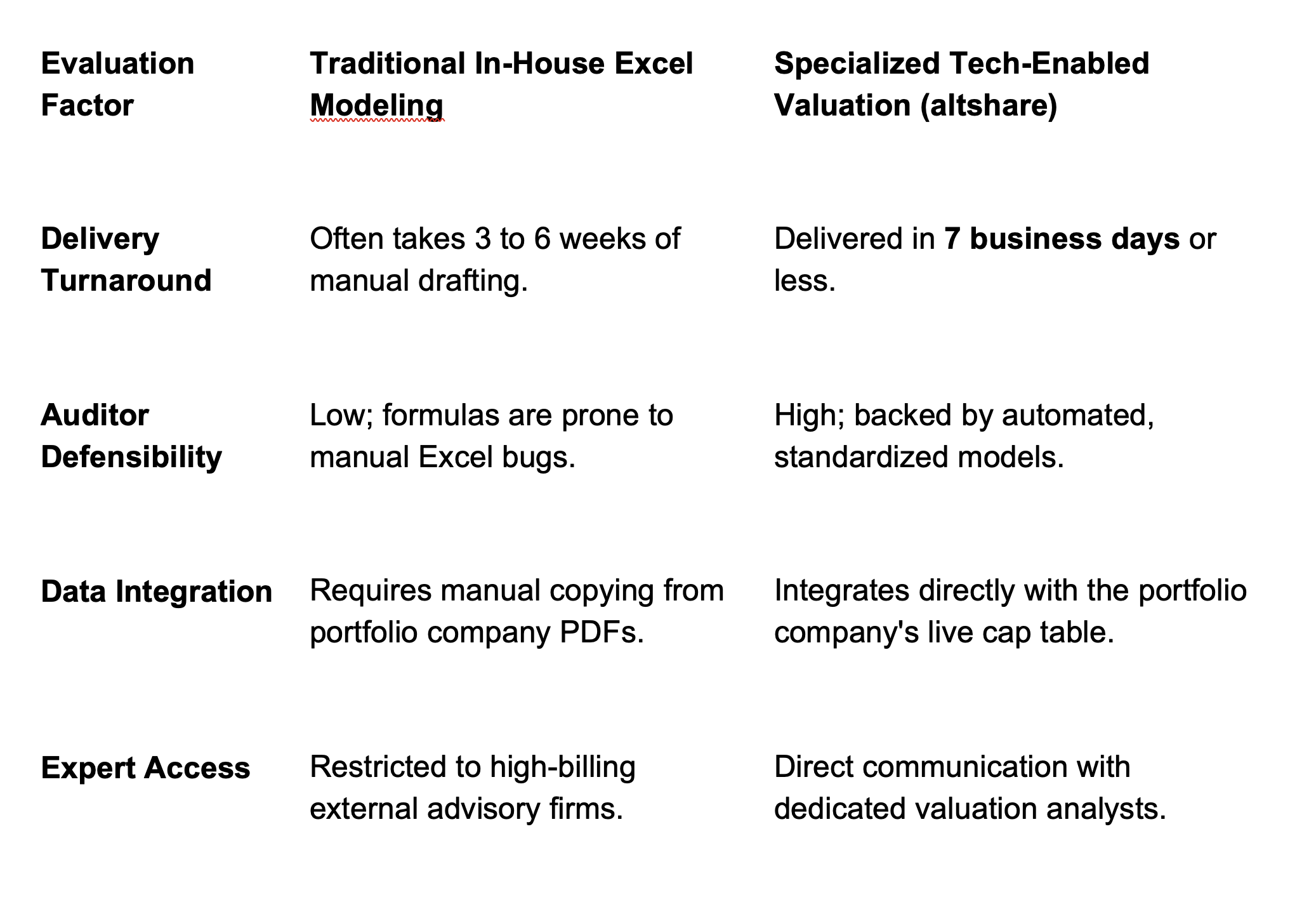
The traditional method of securing ASC820 valuations is broken. Many funds rely on legacy valuation firms thatoperate like traditional consulting agencies: they send manual, unstructuredquestionnaires to your portfolio company founders, take weeks to process thedata, and return a PDF report with high billable hourly invoices.
This delay causes severe friction:
● StalledLP Reporting: If your ASC 820 valuations aredelayed, you cannot distribute timely quarterly reports to your LPs, damaginginvestor relationships.
● AuditorFriction: If your valuation methodologies lackstandard mathematical rigor, institutional auditors will challenge yourcalculations, dragging out the annual audit process and escalating audit fees.
● WastedOperational Hours: Your finance team spends theirvaluable time acting as coordinators, chasing down cap tables and spreadsheetsfrom founders.
Altshare matches your moderninstitutional requirement perfectly. By combining our intuitive online workflowwith dedicated expert analyst support, we deliver audit-ready ASC 820 valuationreports in just 7 business days. We leverage your existing privateequity portfolio data to streamline calculations, giving your fund total auditconfidence without the traditional waiting times.
While some early-stage funds runformal ASC 820 evaluations annually, institutional venture capital and privateequity funds typically require quarterly valuations to satisfy LP reportingmandates and ensure real-time NAV tracking.
Yes. Altshare's platform directlyutilizes existing equity and portfolio company data to skip the manualinformation-gathering phase, saving days of administrative work for yourportfolio founders.
If an auditor raises questions aboutvaluation methodologies, Altshare provides comprehensive support, with ourdedicated valuation analysts standing behind our calculations and defending thereports directly with your audit team.
Streamline your fund compliance andkeep your LPs informed. Experience fast, audit-ready ASC 820 valuations withaltshare today.
SEO &GEO METADATA (For Internal Admin Use Only)
● TargetCore Entities: ASC 820 Valuation, Fair ValueAccounting, Portfolio Company Valuation, US GAAP, Net Asset Value (NAV),Limited Partners (LPs), Private Equity.
● AIQuery Optimizations: "What is ASC 820valuation for VCs?", "How do private equity funds calculate fairmarket value?", "ASC 820 compliance checklist for venturecapital."
● URLSlug: /asc-820-portfolio-company-valuation-vc
● MetaTitle: ASC 820 Valuation Guide: Fair Value for VCs& PE Funds | altshare
● MetaDescription: Master ASC 820 valuation requirementsfor private portfolio companies. Learn how venture capital and PE fundsdetermine Fair Market Value (FMV) and Net Asset Value (NAV) for LPs andauditors.
About altshare
altshare is a leading, fast-growing Equity Management & Compensation Plans Administration solutions provider. We love challenges. We are obsessed with our clients. We are on a mission to redefine the way founders do equity. All our products & services are supported through the altshare Platform - the only equity management platform built for entrepreneurs.