Switching from Pulley? We’re helping hundreds of companies transition quickly and securely. Talk to our team ❯
Switching from Pulley? We’re helping hundreds of companies transition quickly and securely. Talk to our team ❯
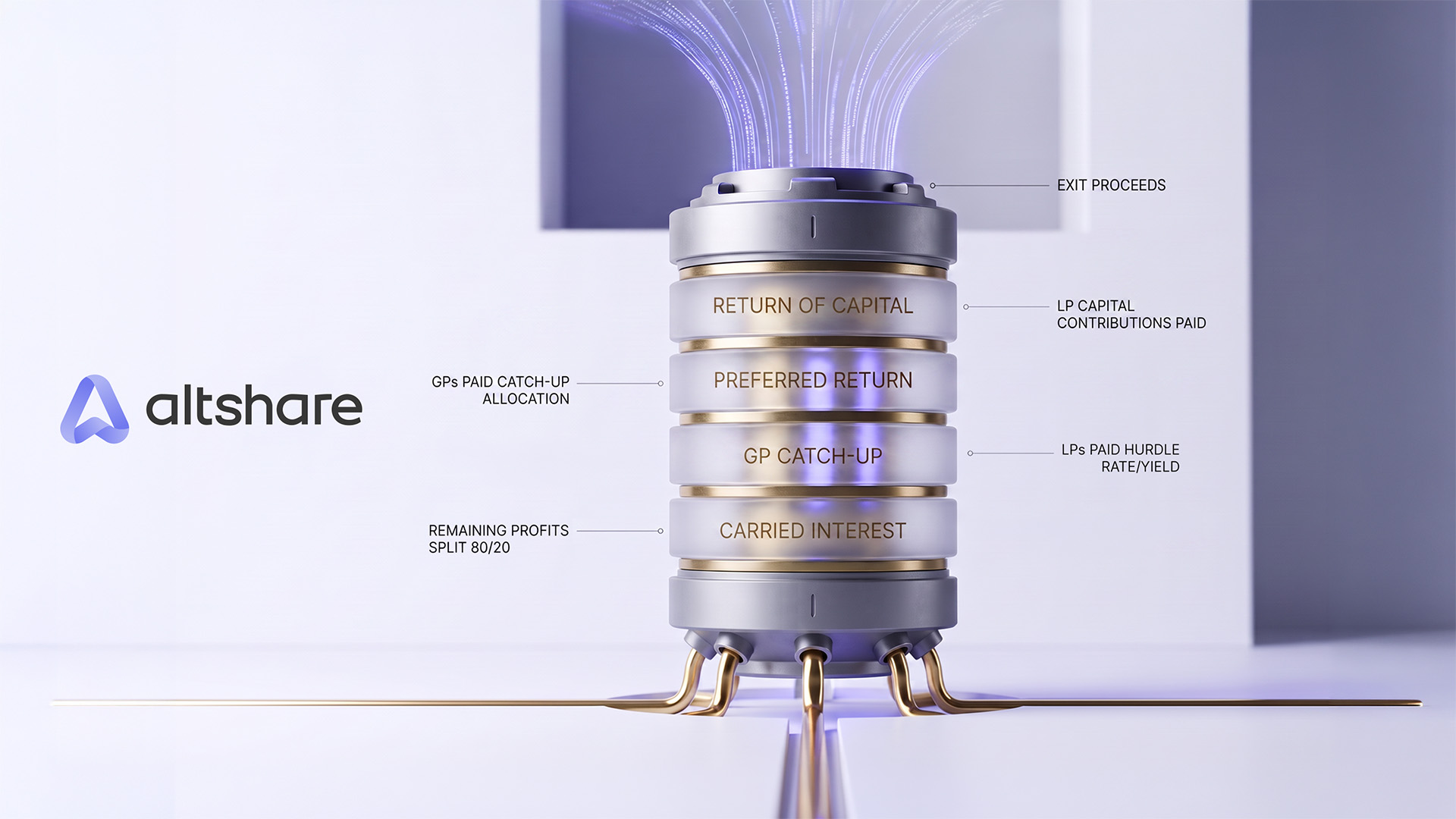


When a private company achieves a liquidity event-such as a major acquisition, merger, or asset sale-the process of distributing the cash proceeds is rarely straightforward. You cannot simply divide the purchase price by the total number of shares and wire the money.
Instead, the funds must flow through a highly structured, legal sequence known as a distribution waterfall.This process ensures that debt holders, preferred investors, and common shareholders are paid in the exact order and proportion mandated by their legal contracts.
For venture capital GPs, private equity sponsors, and corporate finance teams, executing accurate waterfall modeling is critical to navigating an exit smoothly and maintaining absolute compliance during a liquidity event.
A distribution waterfall (or equity distribution waterfall) is a legal and mathematical method used in private equity and venture capital to allocate investment payout proceeds among various classes of shareholders during a liquidity event. The cash "flows down" through a series of prioritized tiers, where each tier must be fully satisfied according to its liquidation preferences and hurdle rates before any capital can spill over into subsequent tiers.
Managing these flows requires deep integration between your legal documentation, your capitalization ledger, and your financial planning tools. Because a single company may have multiple rounds of preferred stock (Series Seed, A, B, C) issued at different times with varying terms, the math behind these calculations scales in complexity with every funding round.
To build an accurate waterfall model, your finance team must map out several critical legal covenants:
This is the foundational safety net for preferred investors. It dictates that in a sale or liquidation, preferred shareholders must receive their initial investment back (or a multiple of it, such as $1\text{x}$ or $2\text{x}$) before any common stock holders receive a single dollar.
Preferred stock can be participating or non-participating:
● Non-Participating: The investor must choose between receiving their fixed liquidation preference or converting their preferred shares into common stock and participating pro-rata in the remaining pool.
● Participating(Double-Dip): The investor receives their full liquidation preference and gets to participate pro-rata in the remaining common stock pool as if they had converted.
Common in private equity and real estate funds, a hurdle rate is a minimum annual rate of return (typically 6% to8%) that must be distributed to investors before the General Partner (GP) can receive any carried interest.
Carried interest represents the GP's share of the profits (usually 20%). A "GP Catch-Up" clause dictates that once the investors have received their initial capital and hurdle returns, the GP receives a disproportionate share of the next distributions until their historical profit share is fully satisfied.
In a standard private equity fund or late-stage venture model, the equity distribution is typically broken down into four distinct structural tiers:
┌────────────────────────────────────────────────────────┐
│ EXIT PROCEEDS │
└───────────────────────────┬────────────────────────────┘
│
▼
Tier 1: Return of Capital (LP CapitalContributions Paid)
│
▼
Tier 2: Preferred Return (LPs Paid HurdleRate/Preferred Yield)
│
▼
Tier 3: GP Catch-Up (GPs Paid Catch-UpAllocation)
│
▼
Tier 4: Carried Interest (Remaining ProfitsSplit 80/20)
Many corporate finance teams still build their exit models manually using Excel. While a spreadsheet works well for basic corporate forecasting, relying on it to run live waterfall calculations during an M&A transaction introduces significant operational risks:
● FormulaFragility: Excel formulas are highly vulnerable to manual typing errors, broken links, and circular reference bugs. During a high-stress transaction, a minor cell reference error can completely distort the payout model, leading to severe legal disputes between share classes.
● TheConversion Dilemma: Non-participating preferred investors must convert to common stock only if the common share payout exceeds their liquidation preference. A spreadsheet model must manually calculate the exact "conversion threshold" for every individual investor round-a process that becomes highly complex when managing a cap table with dozens of historical seed rounds, SAFEs, and option grants.
● VersionControl Failure: Financial analysts, corporate lawyers, and executive founders often exchange multiple versions of the same waterfall sheet over email, leading to catastrophic misalignments during closing due diligence.
Altshare is engineered specifically to capture this high-intent institutional demand. By integrating your live capitalization table directly with our dynamic waterfall modeling suite,we eliminate the need for manual file transfers or complex spreadsheetrecalculations. Whenever a transaction structure changes, you can run new simulations in seconds, ensuring your executive team walks into the boardroomwith absolute mathematical confidence.
A waterfall analysis calculates the exact distribution of proceeds to every stakeholder based on an active, confirmed exit valuation. Scenario modeling is the forward-looking process of running multiple hypothetical exit scenarios (e.g., selling at $50M vs. $100M vs. $250M) to see how different valuation milestones will impact founder and investor returns.
Outstanding SAFEs must convert into equity prior to or concurrent with the liquidity event. The software must calculate whether the valuation cap or the discount rate yields the more favorable conversion price for the SAFE holder, and then immediately factor those newly converted shares into the waterfall distribution.
A clawback is a legal clause that requires the GP to return distributed profits to LPs if subsequent portfolio company performance falls below expectations, or if the GP ultimately received more than their agreed-upon carried interest share over the life of the fund.
Streamline your exit planning and protect your stakeholder relationships. Experience real-time equity distribution simulations and advanced waterfall modeling with altshare today.
About altshare
altshare is a leading, fast-growing Equity Management & Compensation Plans Administration solutions provider. We love challenges. We are obsessed with our clients. We are on a mission to redefine the way founders do equity. All our products & services are supported through the altshare Platform - the only equity management platform built for entrepreneurs.